
Hamilton County People Directory Map
Hamilton County people directories are spread among agencies and archives, so the best first source depends on why a name was recorded. A city employee appears in Chattanooga's roster, a teacher in the district contact search, and a property owner in the county assessment roll. Older residents are more likely to appear in city books, obituary citations, yearbooks, church rosters, or newspapers.
| Name Source | People Included | Maintaining Office | How to Reach It |
|---|---|---|---|
| External Employee Directory | Chattanooga employees by title and division | City of Chattanooga | Free PDF and live department pages |
| HCDE contact search | District staff by name or role | Hamilton County Schools | Free online search |
| UTC directories | Departments, faculty, and staff | University of Tennessee at Chattanooga | Free online directory and profile pages |
| Government and legislative rosters | State agencies, officials, lawmakers, and staff | State of Tennessee | Free directory hub and A-Z browse |
| Assessment and deed indexes | Owners and parties to recorded instruments | Hamilton County | Free assessor; recorder account, request, or counter |
| City directories and phone books | Past residents, owners, occupations, and firms | Chattanooga Public Library | Digital, onsite, and microfilm access |
| Obituary and archive indexes | Decedents, relatives, students, faculty, and group members | CPL and UTC | Online citations, finding aids, and staff requests |
Start with the directory that matches the person's role and date. Then compare a second source before deciding that two same-name entries belong to one person. Hamilton County directories record institutional facts, not one universal identity profile. Current staff lists may change, while an old city volume captures only the year in which it was published.
Chattanooga Government Directory Entries
The Chattanooga External Employee Directory is a browsable roster arranged by city function. Its published columns identify each role, name, and office phone. Since the PDF carries a November 13, 2023 date, confirm a result against the relevant department page. Leadership cards can provide a more current name, title, department, and office number.
The Chattanooga government directory shows how departments and named leaders are arranged:
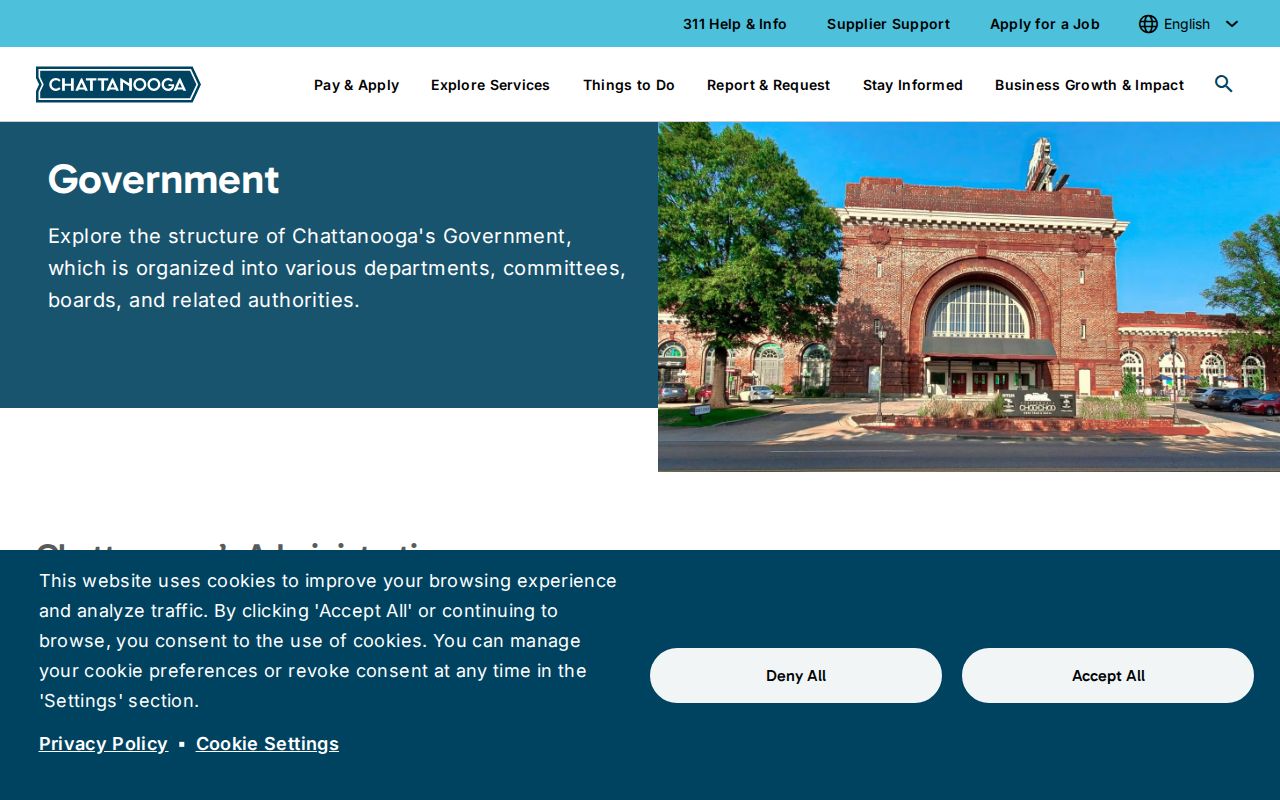
The department-first layout is useful when a title or service is known but the employee's full name is not. Call the listed department number when a person does not appear. A narrow city records request is the next fallback for an official record, but a directory is not proof that an employee held the same role on an earlier date.
- Role: the city title attached to the entry.
- Name: the employee name as the roster publishes it.
- Office Phone: the work contact associated with that function.
- Division: the surrounding roster heading that gives context.
Note: Department pages may be newer than the dated employee PDF, so compare both before relying on a Hamilton County government directory entry.
Hamilton County Education Directories
The Hamilton County Schools contact search accepts a staff member's name or role in one text box. It has no published required flag, filter list, export, result cap, or minimum character count. The district department directory is a sound fallback when the exact name is unknown. HCDE covers 79 schools across a 576-square-mile service area, so a role search can be more useful than guessing a campus.
UTC separates units from people. Its department search uses an optional-looking Department field with the prompt “Search for a UTC Department.” A result may show the department name, phone, fax, mail code, street address, and hours. Faculty and staff pages add person-level detail.
| Directory | Search Label | Input | Published Behavior |
|---|---|---|---|
| HCDE contact search | Search by name or title | Free text | Find district staff by a known name or role |
| UTC Department Directory | Department | Text with autocomplete | Returns unit contact details rather than a universal person list |
The UTC people directory source illustrates the university search surface:
For a named faculty member, use the relevant academic unit page. A verified UTC staff entry can show name, degree, title, roles, email, building and room, phone, image, profile link, and group. Those fields provide far more context than a bare telephone listing.
Hamilton County State Directory Routes
Some public contacts who serve Hamilton County work in state government rather than a county office. The Tennessee Government Directory routes searches to the State Phone Directory, departments, county and city sites, officials, courts, boards, commissions, law enforcement, and the legislator finder. It works best as a directory hub, because each linked roster has its own fields and scope.
The Tennessee General Assembly directory supports A-Z and All browsing. Entries return a name, position, chamber or location, office, and phone. That makes the legislative roster the direct source for a lawmaker or legislative staff contact tied to Hamilton County. It should not be confused with Chattanooga City Council pages or the Hamilton County Commission archive, which document separate governments.
Note: County, city, university, and state directories overlap by geography, but each roster speaks only for the institution that maintains it.
Hamilton County Property Name Directories
The county assessment roll doubles as a present-owner directory. The Hamilton County Assessor search accepts owner name in last-name-first order, street name, street number, or parcel. One complete field is enough. A result can identify the parcel, owner, situs address, assessed and appraised values, property traits, a GIS connection, and the current deed Book/Page. A situs address is the physical parcel address, which is not always where an owner receives mail.
Book/Page provides the bridge to the Register of Deeds. The Register functions as a directory of grantors and grantees, meaning people who gave or received an interest in recorded property. Remote records and images are documented from July 1, 1969, but online access requires an account and monthly fee. Counter inspection and targeted phone, email, or request-form channels remain available. The full rules belong with the Hamilton County public records search.
Other public records can resemble directories without becoming open name books. A voter file lists registered voters under Tennessee's separate access and protected-address rules, and it never reveals ballot choices. Tax and GIS records organize property facts around a parcel. Use each source only for the field and time period its custodian maintains.
GIS verifies parcel geography but does not prove who lives there. A property owner may live elsewhere, and a postal Chattanooga address may sit beyond city limits. Keep ownership, occupancy, mailing, and municipal jurisdiction as separate facts.
Hamilton County Professional Directories
Professional and business sources answer different questions. The Tennessee health license search accepts first, middle, and last name, city, state, ZIP, profession, license number, and CAPTCHA. It is a daily-updated primary source. Results may include professional status, profile information, or discipline data. Exact spelling or the first few surname characters can help, while temporary permit holders require both first and last name.
The Secretary of State business search uses an entity name or control number and may return status, type, formation details, registered agent and address, and filing history. The Chattanooga Chamber directory instead lists members by keyword, category, and geography. Its optional filters include city, county, ZIP, state, and country. The Chattanooga Bar directory offers A-Z member profiles, but it is an association roster rather than the statewide licensing authority.
Chattanooga Directory Years and Gaps
The Chattanooga Public Library's Local History and Genealogy collection holds the key long-run directory set for Hamilton County. City directories span 1871 through 2008. Volumes before 1938 are on microfilm, while Ancestry Library Edition offers U.S. City Directories from 1871 through 1960 for onsite users. The 1904 Hill City Directory is freely digitized.
| Directory Period | Format or Gap | What It Can Establish |
|---|---|---|
| 1871-2008 | CPL's overall Chattanooga run | Residents, owners, occupations, businesses, and addresses |
| Before 1938 | Microfilm at the library | Alphabetical entries and street-based research |
| 1871-1960 | Ancestry Library Edition onsite | Digitally searchable city-directory entries |
| 1904 | Free digitized Hill City volume | A direct online snapshot of Chattanooga residents and firms |
| 1873-1875, 1877, 1879 | No directory published | No inference should be drawn from the missing volume |
Annual entries can show occupation, widowhood, a move, or a change of organization. Street sections reverse the usual process by moving from address to occupant. Publication gaps are the crucial myth check: a missing book does not mean the person left Hamilton County. Annexation can also make an address appear for the first time because directory coverage expanded.
CPL also holds historical telephone books and related local sources. No authoritative current carrier white-pages directory was verified for Hamilton County, so do not substitute a generic current-phone claim for the library's documented holdings. The Local History and Genealogy Department can confirm whether a specific phone book, city volume, newspaper run, or map is available onsite.
Note: Ask the library to confirm the exact volume and format before visiting, especially when a target year falls near a known gap.
Hamilton County Obituary Directories
The Chattanooga Obituary Index covers 1873 to the present and is updated each year. A hit supplies the person's name, publication date, and newspaper. It does not supply the obituary image or transcript. Use the citation to retrieve microfilm or order a copy from the library's Local History and Genealogy Department.
That original notice may identify relatives, residence, church, cemetery, funeral home, pallbearers, or community groups. Search both spouses independently. Before a 2025 data change, spouse or partner details had been recorded only for women's obituaries. The index moved in 2025 to a simpler catalog version and an advanced Open Data Portal version, so an old saved route may no longer lead to the active search.
Church directories, cemetery transcriptions, county marriage material, and newspaper files can then test the relationships suggested by an obituary. They are separate sources. Agreement across two records is stronger than treating an index citation as a complete family directory.
UTC Yearbooks Extend Hamilton Directories
The UTC Chattanooga History Collections and University Archives preserve name sources that conventional people directories miss. All 63 volumes of the Moccasin yearbook are full-text searchable, while university catalogs reach back to 1888-1889. Together they identify students, faculty, class years, campus groups, and predecessor institutions such as Chattanooga University and the University of Chattanooga.
Other holdings include a Chattanooga Ward 2 voter list from 1941-1943, church directories from 1969, 1976, and 1986, a Women's Club yearbook, and law-school student cards and faculty rosters from 1898-1910. Employer collections cover Brock Candy, Dixie Mercerizing, Thacher Medicine, United Hosiery Mills, Wheland Foundry, and U.S. Pipe. These records can reconnect a classmate, congregation member, or factory associate when a courthouse index has no useful role-based entry.
Many collections remain offline. Use a finding aid or Ask an Archivist, and provide the name, likely date, group, and collection. UTC will digitize up to 200 archival scans at no charge. That insider option makes a precise remote request far more useful than asking staff to search every archive for a common surname.
Reading Historical Hamilton County Directories
Historical Hamilton County directories must be read in the geography of their own time. The county was created in 1819. Its seat moved from Dallas to Harrison in 1840 and then to Chattanooga in 1870. Early records may use those place names, and present city limits should not be projected backward. Communities once in James County may also require the surviving James County books through 1919.
The library's street listings, Sanborn maps, plats, newspapers, and clipping files help translate an old address. Search a street without its number when numbering may have changed. Try both names around the 2019 East 5th Street and Mocs Alumni Drive change. A parcel number and deed Book/Page can then connect the historical address to modern county systems.
- Alphabetical city directory
- A surname-first roster that may give address, occupation, employer, spouse, or widowhood.
- Street listing
- An address-first section used to identify occupants along one street.
- Situs address
- The physical location of a parcel, distinct from an owner's mailing address.
- Finding aid
- An archive's description of a collection, its dates, subjects, and boxes rather than a list of every name.
Names also vary. Try initials, middle names, suffixes, married and maiden forms, and spelling variants. Confirm any likely match with a date, address, relative, organization, parcel, or other independent detail. One directory entry is a lead, not proof of identity.