
Which Hamilton County Records Open
No single portal covers the whole county. The Register keeps recorded land instruments, the Assessor maintains the current ownership roll, and separate clerks hold court files. Tennessee citizens have an enforceable right to inspect existing, nonexempt government material under the Tennessee Public Records Act, or TPRA. A portal may show only an index, which is a searchable list of identifying details, while the full image or certified copy stays with the custodian.
| Hamilton record set | Official keeper | Web route | Practical access |
|---|---|---|---|
| Deeds, liens, plats | Register of Deeds | Account database, July 1, 1969 forward | $50 monthly account, counter, phone, email, or request form |
| Ownership and parcel | Assessor and GIS | Free current search and map | Web or office counter |
| Civil and probate cases | Circuit Clerk or Clerk & Master | Separate case portals | Web docket, clerk inspection, or copy request |
| Criminal cases | Criminal Court Clerk | Daily-updated docket | Web docket or clerk verification |
| Birth, death, marriage, divorce | Health Department, state, clerk, or court | No open modern name index | Eligible certificate request; older files through archives |
| Inmate and offender data | Sheriff, TDOC, or TBI | Free official lookups | Confirm a match with the originating agency |
Juvenile and adoption matters, sealed or expunged cases, military discharge forms held by the Register, protected voter addresses, and motor vehicle personal data have statutory limits. Recent vital certificates also require proof of entitlement. Public status never means that every page appears online, and redaction may remove a confidential field from an otherwise open file.
Hamilton County Deed Access Choices
The Hamilton County Register of Deeds records deeds, mortgages, liens, plats, powers of attorney, and related instruments. Remote data and images are documented from July 1, 1969 forward. Remote searching requires an account that costs $50 per month. Once signed in, users may search by Party, Book and Page, Document, Property, Party and Property, Index, or Quick mode.
That subscription is only one channel. The public may inspect records at the Room 400 counter, call or email for an ordinary document, or submit the Register request form for inspection, paper copies, duplicates, or electronic delivery. Inspection is free. Requests costing $3 or less are waived; larger work may require an estimate and prepayment. Computer copies sent by email cost $0.15 per page, while emailed microfilm costs $1 per page. Personal extraction devices are not allowed at the office.
The official Register login shows the account gateway used for Hamilton County deed access:
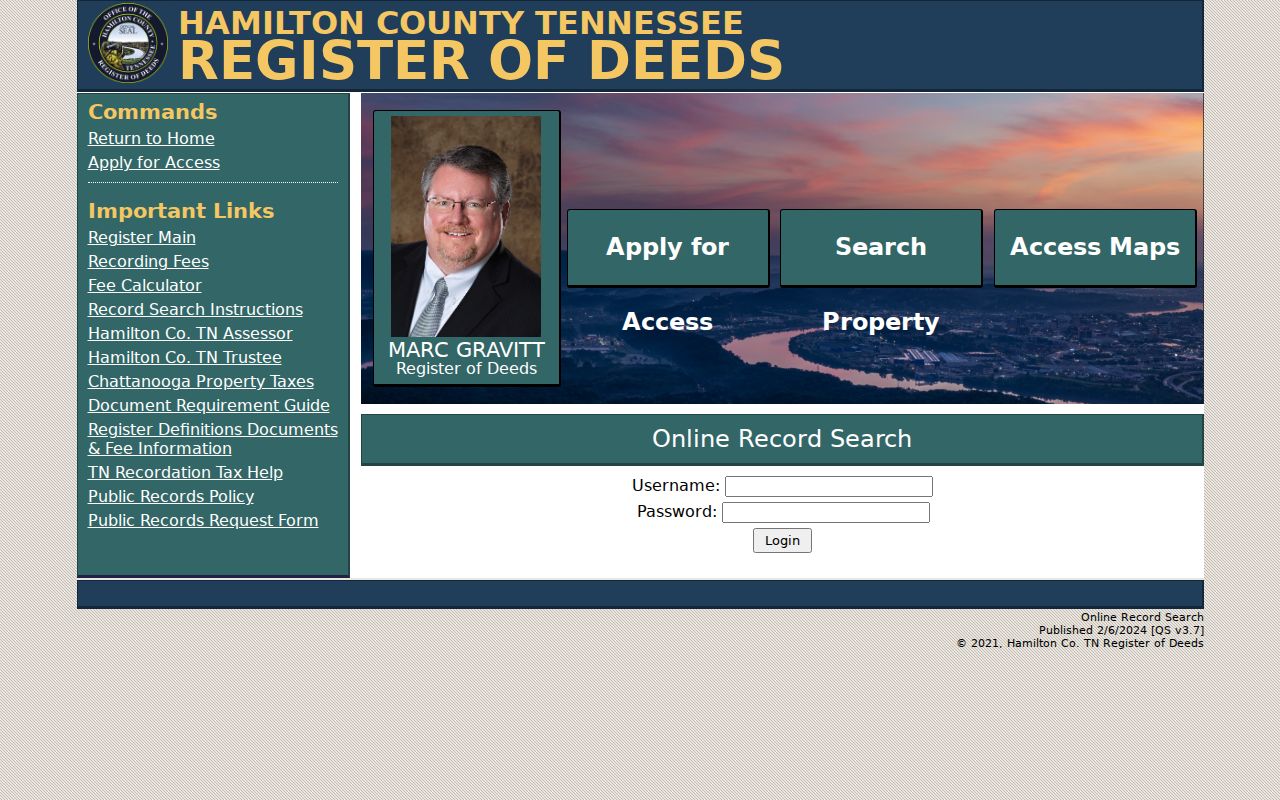
The screen makes the access boundary clear. It is a credentialed system, so a counter visit or a narrow book-and-page request may be the better route for one document.
Note: TSLA microfilm reaches older deed books and direct, grantor, reverse, and grantee indexes that predate the remote database.
Hamilton County Assessor Search Fields
The Assessor provides the strongest free bridge into the paid land-record system. Search by the owner’s last name first, a street name, a street number, or the parcel identifier. One complete field is enough. A result can supply the current owner, situs address, parcel number, values, property traits, and current deed Book and Page. “Situs” means the physical parcel address, not necessarily the owner’s mailing address.
| Portal field | Input | Required | Hamilton format note |
|---|---|---|---|
| Street Name | Text | No | A street alone can return the whole street; use “Main” or “Main St” |
| Street Number | Text | No | Narrows a street-name search |
| Parcel | Text | No | Examples include “139 001.01” and “129P B 010” |
| Owner | Text | No | Enter surname first, such as “Doe John” |
Record the parcel and Book/Page, then confirm the location with Hamilton County GIS. That sequence can avoid a full Register subscription. A street-name-only search also helps when the number has changed. Ownership and occupancy are different facts, so a person named on the tax roll should not be assumed to live at the parcel.
Note: Preserve parcel spacing exactly as the Assessor shows it before moving between the property, map, tax, and deed systems.
Hamilton County Court Record Routes
Court records split by subject. Circuit Court and Sessions Civil use TN Case Finder, which advertises party name, filing date, attorney name, and other options. Chancery handles estates, wills, heirs, trusts, guardianships, equity, and probate. Criminal and Sessions Criminal have a separate daily-updated docket. Chattanooga City Court covers ordinance, traffic, parking, animal, refuse, and environmental cases, while Juvenile Court has no general public lookup.
A docket can show a party or defendant name, case number, court type, filing and hearing dates, attorney, and a published disposition. It is not always the full pleading. Circuit, Sessions Civil, and Chancery copies are $0.50 per page. Certification is $5, with page charges added where the clerk states that rule. Sealed, expunged, adoption, and juvenile material does not become open because another case appears in the same portal.
- Circuit Court Clerk: Circuit cases, appeals, and Sessions Civil.
- Clerk & Master: Chancery and probate records.
- Criminal Court Clerk: Criminal and Sessions Criminal dockets.
- City Court Clerk: Chattanooga ordinance and citation cases.
- Federal clerk: Eastern District of Tennessee files through PACER or the clerk.
Note: An online name match does not prove identity; compare dates, case numbers, and other lawful identifiers with the clerk’s source file.
Hamilton County Probate Record Custodian
Probate is in Chancery Court, not at the Hamilton County Clerk. The Clerk & Master holds estates, wills, trusts, guardianships, and related files. Its portal permits searches by court type, case type, case, or party. When the docket lacks the needed paper, ask the Room 300 office for inspection, a copy, or electronic delivery and include the record type, date range, subject, keywords, and any known case number.
This split matters for estate and heir research. The County Clerk handles marriage and other statutory clerk services, but it is not the probate custodian. Clerk & Master copy requests of $3 or less are waived, while larger estimates may be prepaid. A certified copy costs $5 plus page charges. Narrow terms save review time and help the office locate an existing file without being asked to create a new family compilation.
Hamilton County Vital Record Boundaries
There is no open modern name index for every vital event. The Hamilton County Health Department can issue statewide birth and death certificates at 921 East Third Street. The Tennessee Office of Vital Records maintains modern certificates, the County Clerk retains local marriage licenses, and the court that granted a divorce holds its decree and case file. Requests may be made in person or by mail. The state also names VitalChek as its sole authorized online card vendor, with added vendor and shipping charges. Mail requests use a signed form, the fee, and either accepted identification or a notarized application.
Tenn. Code Ann. § 68-3-205(e) opens births after 100 years and deaths, marriages, divorces, and annulments after 50 years. Within those periods, the state generally limits copies to the person named, close family, a guardian, or a documented representative. The standard search and one-copy fee is $15. Older state-held records transfer to the Tennessee State Library and Archives, where indexes, the research room, and mail services provide the fallback.
Certificate limit. A public docket or index entry does not make every underlying medical report, application, pleading, or sealed certificate open for inspection.
Note: The $15 state search fee is retained when no certificate is found, so verify the event name and year first.
Hamilton County Public Records Desks
Use the office that created or maintains the requested record. These three desks cover recorded instruments, major county civil files, and Chattanooga municipal requests. They do not replace the Assessor, Criminal Clerk, Health Department, or other custodians when those offices own the source file.
Hamilton County Register of Deeds
625 Georgia Avenue, Room 400
Chattanooga, TN
(423) 209-6560
Monday through Friday, 8 a.m. to 4 p.m.
Hamilton County Circuit Court Clerk
625 Georgia Avenue, Room 500
Chattanooga, TN
(423) 209-6700
Circuit records and TN Case Finder
Chattanooga Open Records
100 E. 11th Street, Suite 200
Chattanooga, TN 37402
(423) 643-8250
City, police, and police-report request paths
The city route supports inspection, pickup, mail, electronic delivery, and tracked requests. The Chattanooga Open Records entry screen separates city and police channels:
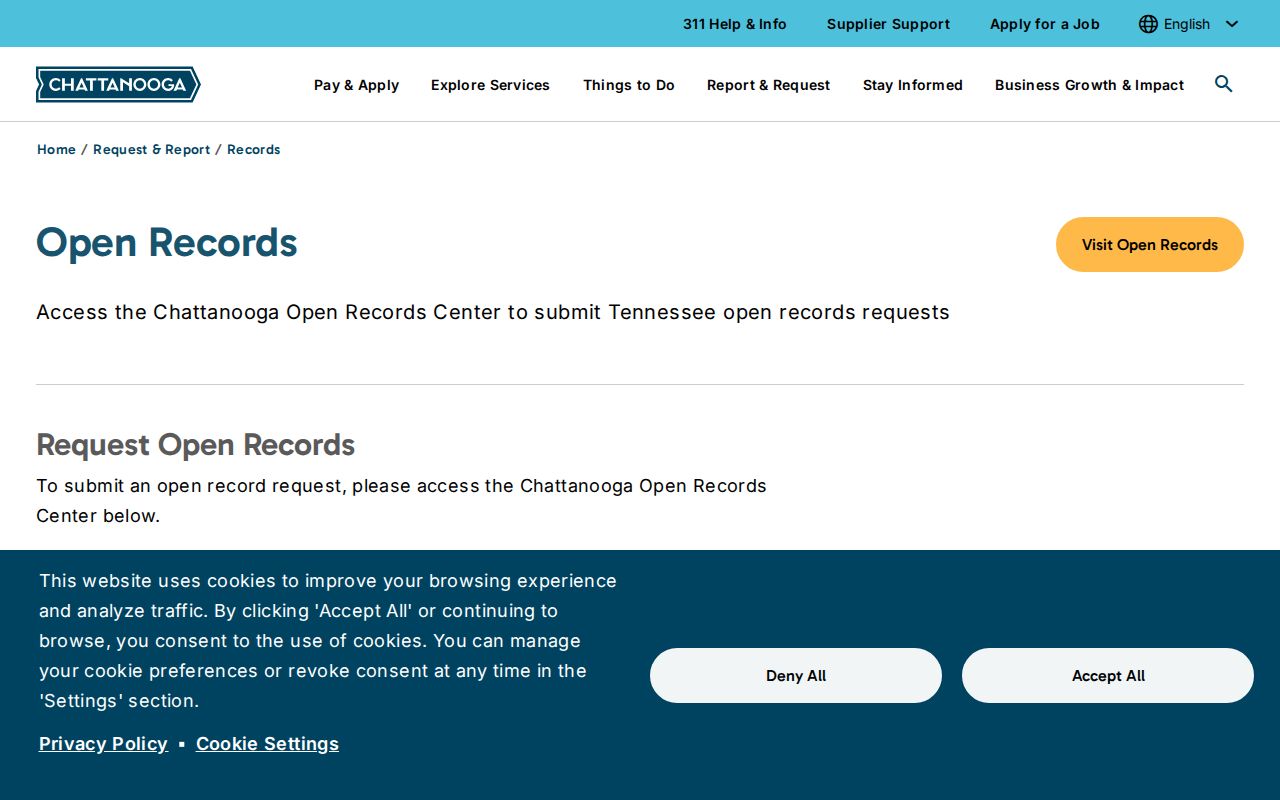
That division prevents a city request from being sent to a county clerk who does not hold the file.
Hamilton County Safety Record Limits
The Sheriff’s inmate search accepts a last name or SPN and can display a photo, name, birth date, bond, judge, division, court date, and visit or notification links. Tennessee’s FOIL covers current and former felony custody or supervision. The TBI registry permits name and location searches for designated statutory profiles, while VINE offers free confidential custody-event notices.
A jail match describes detention, not conviction. An absence from FOIL does not rule out a local matter or a case outside TDOC supervision. Registry and offender results can also involve people with the same name. Verify the record with the Sheriff, court, TDOC, or TBI before relying on it, and use VINE instead of repeatedly republishing sensitive custody details. City police, fire, 911, and accident reports go through Chattanooga Open Records; county-event records use the Sheriff’s records channels. Access to an unredacted crash report may require proof of a qualifying relationship.
Hamilton County Property Alert Limits
The Register’s Property Alert is a free, forward-looking notice service. It is not a title search and does not report old filings retroactively. The matching rules are sensitive to how a name is entered. Leaving out a middle name can catch entries with any middle name, while supplying one narrows the match. A suffix belongs at the end of the middle-name field, and personal and business names need separate registrations.
The official Hamilton County Property Alert form lets a registrant monitor name or address variants:
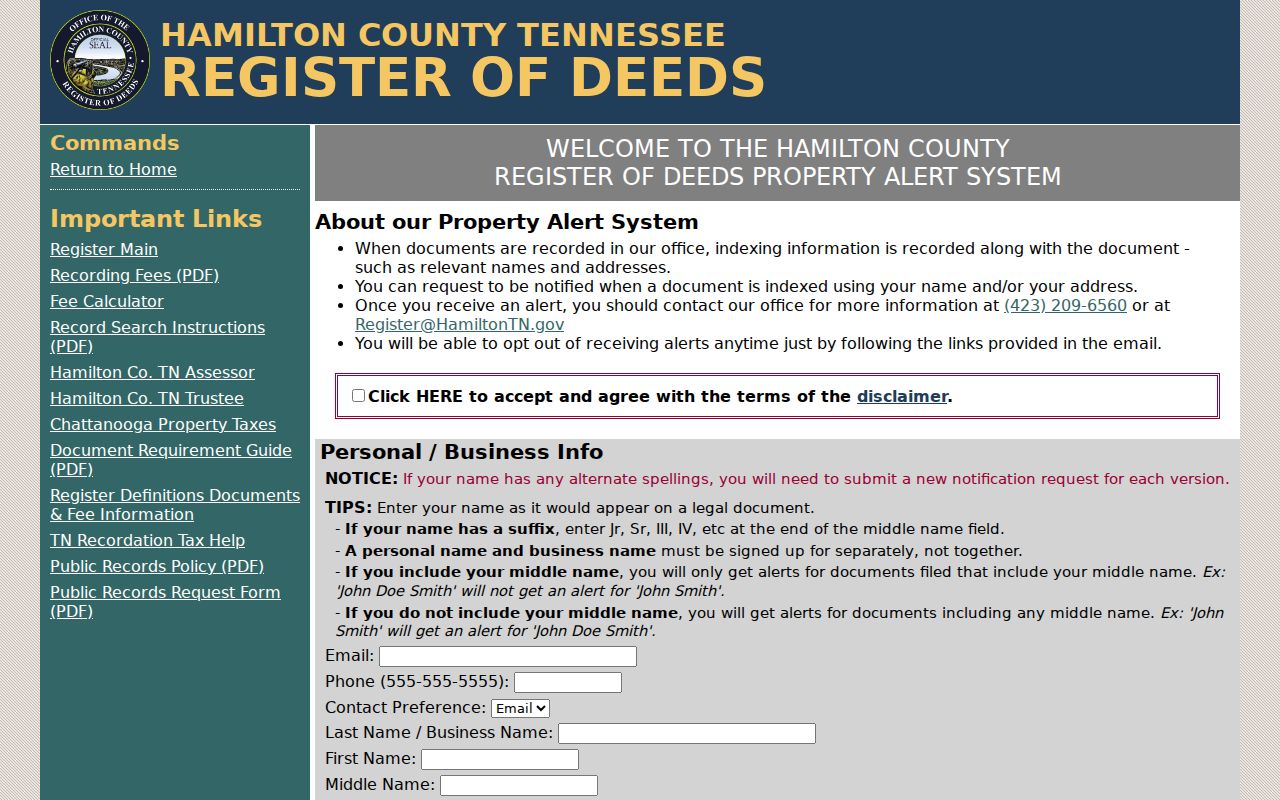
The form is useful for new indexed activity, but a recorded document may omit an address. Check the deed index and source image when a notice arrives.
Historic Hamilton County Records Geography
Early records may use a place name that no longer matches the modern county seat. Hamilton County’s seat moved from Dallas to Harrison in 1840 and to Chattanooga in 1870. The WPA Historical Records Survey preserved Deed Book F from 1844 through 1848 on microfilm in 1936. Those facts make TSLA finding aids and old grantor or grantee indexes vital when the current Register database stops.
Former James County adds another route for northeastern communities. Surviving books from 1912 through its dissolution after bankruptcy in 1919 include marriage, minute, magistrate, assessor, inventory and settlement, deed-acknowledgment, and bond or letter records. Hamilton County warns that courthouse fires may have caused losses. Search both Hamilton and James jurisdictions when the location and date point to that former county.
Tennessee Records Terms Defined
A few terms separate a portal hit from an official copy. Their meaning also helps frame a precise request to the Hamilton County custodian.
- Custodian
- The government office that maintains and can produce the requested record.
- Index
- A searchable list of names, dates, numbers, and record types. It may not include the underlying image.
- Certified copy
- A copy authenticated by the clerk or office as an official reproduction.
- Exemption
- A law that closes a record or permits a specific field to be withheld or redacted.
- Book and Page
- The reference that points to a recorded land instrument in the Register’s collection.
Ask whether the goal is inspection, an ordinary copy, or a certified copy. Each choice can change cost, delivery, and the amount of work the office must perform.
Request Hamilton County Public Records
The Tennessee Public Records Act, Tenn. Code Ann. §§ 10-7-501 through 10-7-515, gives Tennessee citizens access to existing nonexempt records. Readily available material should be produced promptly. If that is not practical, the custodian has seven business days to produce it, deny it in writing with the legal basis, or explain the delay and give a reasonable production date. Inspection is free, though copies, labor allowed by policy, delivery, media, or outside vendors may cost money.
- Choose the custodian. Identify the office that made or keeps the record. City, county, court, and state files use different request routes.
- Check the official index. Capture a parcel, Book/Page, docket, date, or other number that narrows the search.
- Describe an existing record. Give names, record type, date range, office, keywords, and known identifiers. An agency need not create a new compilation.
- Select access and delivery. State whether inspection, paper, or electronic copies are wanted and choose pickup, mail, or electronic delivery.
- Review the response. Provide proof of Tennessee citizenship if lawfully required, prepay an estimate when needed, or narrow an overbroad request.
A written form may be required for copies, but an inspection-only request cannot be forced onto a written form. If access breaks down, the Tennessee Office of Open Records Counsel can explain the law and mediate, though it does not fetch the file. A judicial access action is available under Tenn. Code Ann. § 10-7-505.
Lawful personal use. Records may support genealogy, heir research, correcting personal data, scam checks, and civic review. Never use them to stalk, threaten, harass, impersonate, or defeat a protected address.